

Teams often look for a single account characteristic that will predict the outcome of App Review: the registration method, the country, or the membership type. That search produces simple formulas such as "use only Device Made," "this GEO is working now," or "Company is always stronger than Individual."
The experience of SmartShop points to a different conclusion. Since 2024, we have sold more than 2,000 Apple Developer accounts and worked closely with developers, app studios, traffic-arbitrage teams, and solo operators. The same account types can produce very different outcomes for different teams, while yesterday's market favorite can be replaced by its exact opposite a few months later.
The reason is straightforward: the account matters, but it is only one part of the publishing infrastructure. Web Made, a particular GEO, or a Company label cannot compensate for problems in the app, metadata, build, or operating process.
The short version: three conclusions
- Web Made and Device Made describe different registration flows; they are not ready-made reliability scores.
- GEO is useful only when considered together with the team's infrastructure and its own data, not as a universal approval multiplier.
- Company and Individual support different organizational needs and should be selected for the app and operating model.
Core principle. Registration method, GEO, and membership type are configuration and testing variables — not a button that guarantees App Review approval.
Why the market prefers simple explanations
After a successful publication, the easiest detail to remember is the most visible one. If an app was approved from a Device Made account in a particular country, the device or GEO quickly receives the credit. Dozens of other factors disappear from the story: product quality, category, SDKs, submission history, metadata, timing, build preparation, and the team's experience.
This is how correlation becomes a rule. One successful case is repeated in industry chats, two similar observations are added, and soon the market is discussing a new "working setup." Sellers can reinforce the cycle because a scarce batch — or simply the batch they need to move — becomes easier to position as inventory with special trust.
At SmartShop, we do not change the price within a category based on GEO or registration method. We treat these as account characteristics, not as a reason to promise a higher probability of publication.
Myth #1: One registration method is more reliable

In market terminology, Web Made refers to accounts created through a browser-based registration flow, while Device Made refers to accounts created with a device involved in the process. Both options have accumulated their own stories.
Supporters of Web Made point to less dependence on a particular device. Supporters of Device Made see the use of a real device as a sign of more natural registration. Neither explanation turns the creation method into a universal forecast of account lifetime or review outcome.
We see demand move in cycles. During one period, teams request mostly Web Made accounts because several recent cases went well. Later, successful publications from Device Made accounts change the market narrative. If one method offered a durable advantage under all conditions, opinion would not reverse so regularly.
Most comparisons are weak because too many variables change at once: supplier, batch, GEO, documents, account age, app, build environment, and the team itself. Comparing one Web Made account with one Device Made account says almost nothing about a repeatable pattern.
How to use this characteristic properly
- Split volume across different registration flows when you want to reduce dependence on one process.
- Compare a series of submissions, not two isolated accounts.
- Record the app, date, account type, GEO, review outcome, and subsequent history.
- Revisit conclusions regularly; a useful hypothesis does not remain valid forever.
Verdict. Web Made and Device Made are useful diversification variables. Neither option can honestly be sold as guaranteed to have "higher trust."
Myth #2: There is one GEO where almost everything passes

The "best GEO" story spreads quickly because it is easy to understand and easy to sell. Name one country as the new leader, mention a few teams that supposedly use only that location, and demand follows. Later, another GEO takes the lead and the previous theory quietly disappears.
Teams can genuinely achieve more stable results with certain countries. Usually, however, the advantage comes from accumulated experience rather than magic in the flag. Processes are already established for that GEO; documents, payment infrastructure, access, and operating scenarios are familiar. The team knows how to manage the account and makes fewer operational mistakes.
As a result, one team's favorite GEO can be inconvenient for another. Copying only the account country — without the process that supported it — rarely reproduces someone else's statistics.
How to test GEO without misleading yourself
- Select countries for which you can maintain proper infrastructure.
- Distribute volume evenly enough that one case does not determine the conclusion.
- Track more than the first approval: include repeat submissions, operating stability, and overhead.
- Avoid changing the GEO, app, build environment, and team at the same time, or you will not know what affected the outcome.
Verdict. The best GEO is not the country with the loudest reputation in industry chats. It is the country for which your team has a clear, repeatable process.
Myth #3: Company is automatically stronger than Individual
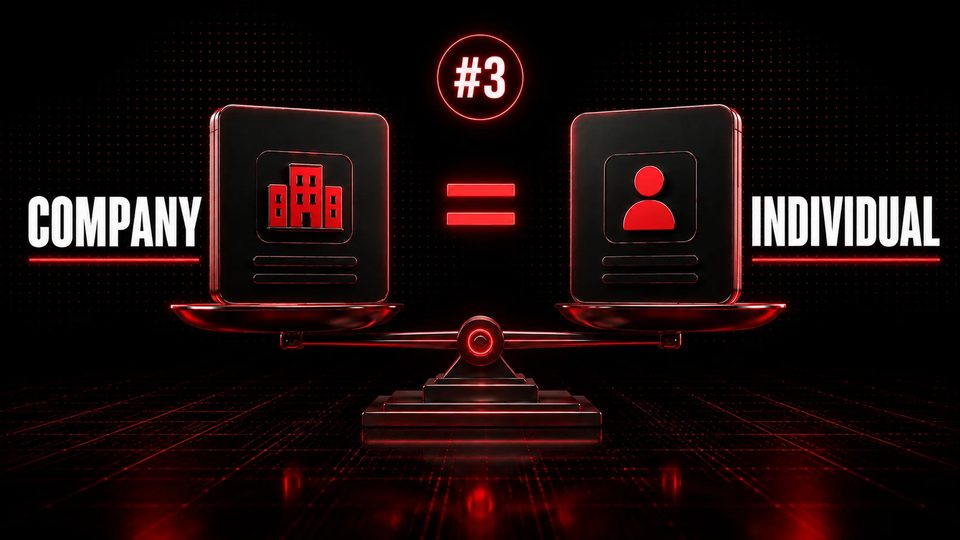
Company and Individual accounts are often placed on a single scale, as if Company were a premium tier and Individual were a simplified, less reliable version. In practice, they are formats designed for different needs, not different trust levels.
With an Individual account, the account holder's name appears as the seller in the App Store. With a Company account, the app is published under a legal entity's name. Certain categories, capabilities, or business scenarios may require an organization account. For other products, Individual fully matches the task and introduces no additional limitation.
Registration to a company does not fix the app or automatically produce a softer review. Likewise, registration to a person does not make an account inherently weaker.
Verdict. Choose Company when the legal-entity format is needed and Individual when a personal membership fits the project. Neither type provides an independent approval guarantee.
What actually affects the outcome

In our experience, stability comes from the quality of the full system — not from finding one "correct" account. The result can be affected by:
- the app's purpose, category, functionality, and consistency with its stated use case;
- code quality, build stability, and the SDKs in use;
- the name, description, screenshots, privacy information, and other metadata;
- submission history and the way the team responds to review feedback;
- discipline around access, documents, roles, and payment information;
- operational hygiene: a controlled build environment, stable configurations, and no accidental traces of older problematic projects;
- the team's ability to identify recurring rejection causes instead of replacing the account after every Reject.
This is why two clients can buy similar accounts and receive different results. One has a consistent process from build preparation to responding to review feedback. The other changes only the GEO or registration method while leaving every other issue untouched.
How to evaluate claims about a "working setup"

Any market observation can be treated as a hypothesis, but not as a guarantee. Before changing procurement or operations, ask four questions:
- How many accounts support the conclusion?
- Over what period was the data collected?
- Were the apps and submission conditions comparable?
- What outcome was measured: first approval, account lifetime, repeat publications, or absence of restrictions?
Claims such as "everything passes from this GEO," "Company has maximum trust," or "this account will definitely last" are red flags. Nobody outside Apple controls App Review or can honestly promise that result.
The SmartShop approach

We do not look for one account that should fit every team. SmartShop offers Web Made and Device Made accounts across more than 10 GEOs, including both Individual Apple Developer accounts and Company Apple Developer accounts. Teams and solo media buyers can select different configurations for their use case and testing plan.
Within each category, pricing stays the same regardless of GEO or registration method, so a temporary market trend does not create an artificial premium. Payment is made after the account is received and checked, and the standard guarantee is seven days.
We do not promise 100% approval because no responsible supplier can make that promise. Our role is to provide a verified account, help within our area of expertise, and enable the team to build diversified, manageable infrastructure.
Bottom line
Web Made or Device Made, a particular GEO, Company or Individual — each is a meaningful selection parameter. It becomes useful only when the team evaluates it in the context of the app, the operating process, and its own data.
Do not buy the story of a single "approval-ready" configuration. Test in series, record the conditions, isolate variables, and build a system that does not depend on one account, one GEO, or one supplier.
Key takeaway. Strong publishing infrastructure is built on discipline and data. The account is an important component, but it cannot replace the system around it.
Individual $350 · Company $650 · Renewal $200. Web Made and Device Made accounts across 10+ GEOs. Contact us to find the right option.
Message on Telegram